Metrovy'a Dön

Metronom, BPM ve Tempo:
Müzisyenin Tam Rehberi

Metronom kullanmak müzisyenlerin en değerli alışkanlığından biridir. Bu rehberde metronomanın ne olduğunu, BPM'in nasıl çalıştığını, tempo terimlerini, otomatik artış modunu ve enstrüman akordunu adım adım öğreneceksiniz.

01 — Temel Bilgi

Metronom Nedir?

Metronom, müzisyenlerin belirli bir tempoyu (hızı) koruyarak pratik yapmasına yardımcı olan ritim tutma aracıdır. "Metronom" kelimesi Yunanca métron (ölçü) ve nomos (kural) sözcüklerinden gelir; yani "ritim düzenleyici" anlamına taşır.

İlk mekanik metronom 1815 yılında Johann Nepomuk Mälzel tarafından icat edilmiştir. Sarkaçlı bu aygıt, belirli bir frekansta ileri geri salınarak müzisyene sabit bir ritim referansı sunuyordu. Günümüzde dijital ve online metronommlar tıklama sesi, görsel gösterge ve gelişmiş özelliklerle çok daha işlevsel hale gelmiştir.

Metrovy gibi bir online metronom, müzik pratiğini kolaylaştırmak için sabit tempo, otomatik BPM artışı ve canlı akort gibi araçları tek bir platformda sunar. Enstrüman ne olursa olsun — gitar, piyano, davul, keman — düzenli metronom pratiği doğru ritim duygusu (groove) geliştirmenin temel yoludur.

💡 Neden önemli?

Araştırmalar, düzenli metronom eşliğinde pratik yapan müzisyenlerin tempoyu koruma başarısının, metronomsuz çalışanlara göre çok daha hızlı geliştiğini göstermektedir. Müzik eğitimcilerinin büyük çoğunluğu her pratik seansında metronom kullanılmasını tavsiye eder.

02 — BPM

BPM Nedir ve Nasıl Hesaplanır?

BPM, İngilizce "Beats Per Minute" ifadesinin kısaltmasıdır ve Türkçeye dakikadaki vuruş sayısı olarak çevrilir. Müziğin hızını sayısal olarak ifade etmenin evrensel yöntemidir.

Örneğin 60 BPM, dakikada 60 vuruş demektir — yani her vuruş tam olarak 1 saniyede bir gelir. 120 BPM'de her vuruş 0,5 saniyede bir gelir; tempo iki katına çıkmıştır. 240 BPM'de ise her vuruş yalnızca 0,25 saniyede bir düşer.

Formül: Vuruşlar arasındaki süre (saniye) = 60 ÷ BPM
Örnek: 80 BPM için → 60 ÷ 80 = 0,75 saniye aralık

Metrovy'daki Tap Tempo özelliği sayesinde parçanın BPM'ini elle hesaplamak zorunda kalmazsınız: ekrana ritme göre dokunduğunuzda uygulama ortalamayı hesaplar.

03 — Tempo Terimleri

Tempo Terimleri ve Anlamları

Müzik notalarında tempo, genellikle İtalyanca terimlerle ifade edilir. Bu terimler hem ifade tarzını hem de yaklaşık BPM aralığını tanımlar.

Terim Türkçe Anlamı BPM Aralığı
Larghissimo Son derece yavaş < 24
Largo Geniş, ağır 24 – 54
Lento Yavaş 40 – 60
Adagio Sakin, yavaş 55 – 75
Andante Yürüyüş hızında 72 – 108
Moderato Orta hız 108 – 120
Allegretto Biraz hızlı 112 – 120
Allegro Hızlı, canlı 120 – 156
Vivace Canlı, hareketli 156 – 176
Presto Çok hızlı 168 – 200
Prestissimo Mümkün olan en hızlı > 200
📌 Not

Bu BPM aralıkları genel bir rehberdir; besteciler zaman zaman aynı terimi farklı BPM değerleriyle işaretlemiş olabilir. Metrovy, mevcut BPM değerine göre tempo terimini otomatik olarak ekranda gösterir.

04 — Ölçü & Alt Bölünme

Ölçü ve Alt Bölünme

Ölçü (time signature), bir ölçü içindeki vuruş sayısını ve hangi nota değerinin bir vuruşu temsil ettiğini belirtir. En yaygın ölçüler:

4/4 — Her ölçüde 4 vuruş, dörtlük nota bir vuruştur. Pop, rock ve jazz'ın büyük çoğunluğu bu ölçüdedir.
3/4 — Her ölçüde 3 vuruş. Valsin karakteristik ölçüsüdür.
2/4 — Her ölçüde 2 vuruş. Marşlarda ve dans müziğinde yaygındır.
6/8 — Her ölçüde 6 sekizlik nota; genellikle 2 büyük vuruş gibi hissedilir. Halk müziği ve bazı rock şarkılarında kullanılır.

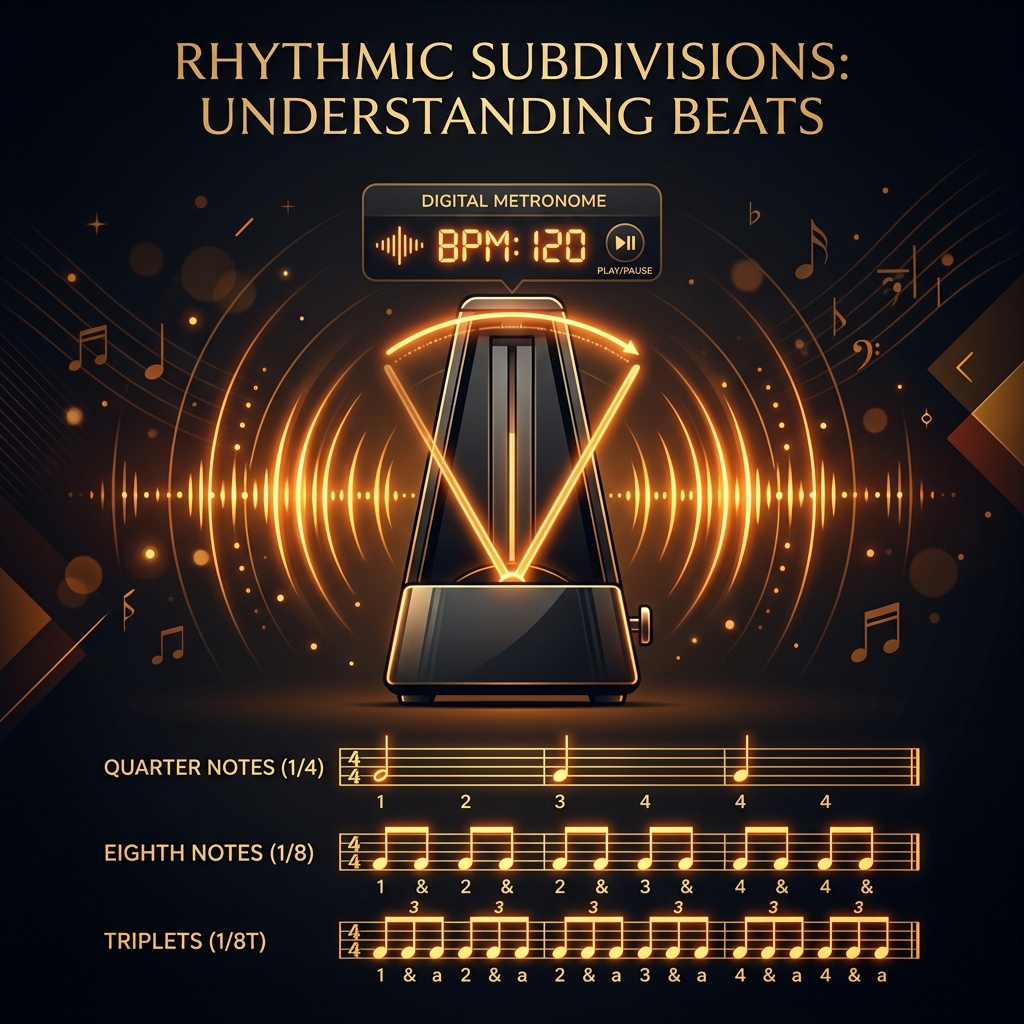
Alt bölünme (subdivision) ise her vuruşu kaç parçaya böldüğünüzü belirler. Dörtlük (1×), sekizlik (2×) ve üçleme (3×) alt bölünmeler en sık kullanılanlardır. Metrovy'da alt bölünme seçeneği, vuruşlar arasındaki hassas zamanlama duygunuzu geliştirmenize yardımcı olur.

05 — Otomatik Artış

Otomatik BPM Artışı Nasıl Kullanılır?

Otomatik BPM artışı, müzisyenlerin hız antrenmanı (speed training) yapmasında kullanılan en etkili yöntemlerden biridir. Bir parçayı çok düşük bir tempoda kusursuz hale getirdikten sonra kademeli olarak hız artırarak hedef tempoya ulaşmak, kasların ve sinir sisteminin doğru motor örüntüyü öğrenmesini sağlar.

Metrovy'un Otomatik Artış modu şu ayarları destekler:

Başlangıç BPM: Pratiğe başlayacağınız tempo.
Bitiş BPM: Ulaşmak istediğiniz hedef tempo.
Artış miktarı: Her adımda kaç BPM artacak (örn. +1, +3, +5).
Artış aralığı: Kaç saniyede bir BPM yükselecek (örn. her 60 saniyede bir).

🎯 Örnek Antrenman Planı

Hedef tempo 140 BPM olan bir riff için: Başlangıç 80 BPM → Bitiş 140 BPM → Her 60 saniyede +2 BPM artış. Bu ayarla yaklaşık 30 dakikada hedefe ulaşılır. Hataların arttığı noktada tekrar başa alarak o bölgeyi yoğunlaştırın.

Döngü (loop) modu aktif olduğunda hedef BPM'e ulaşıldığında metronom başlangıca döner ve antrenman kendiliğinden sürdürülür. Bu özellik özellikle uzun pratik seansları için idealdir.

06 — Akort

Akort (Tuner) Nedir? Nasıl Kullanılır?

Akort, enstrümanın sesini standart referans frekanslarıyla eşleştirme işlemidir. Standart akort A4 = 440 Hz referans alınarak yapılır; ancak bazı orkestralar 442 Hz veya 443 Hz kullanabilir.

Metrovy'daki Canlı Akort (Tuner) özelliği, cihazınızın mikrofonu aracılığıyla enstrümanınızın sesini gerçek zamanlı olarak analiz eder. Ekrandaki ibre sola kaydığında ses kalın kalmıştır (flat), sağa kaydığında ince kalmıştır (sharp). İbre tam ortadayken akort tamamdır.

Gitar için standart akort: E2 – A2 – D3 – G3 – B3 – E4
Bas gitar için: E1 – A1 – D2 – G2
Keman için: G3 – D4 – A4 – E5

Metrovy, bu enstrümanlar için hazır nota düğmeleri sunar. Referans tonu çalarak kulağınızla da akort yapabilirsiniz; bu yöntem işitme eğitimi (ear training) için son derece değerlidir.

07 — İpuçları

Pratik İpuçları

Metronom kullanımından en yüksek verimi almak için aşağıdaki stratejileri deneyin:

🐢
Yavaş Başlayın
Parçayı hatasız çalabileceğiniz en düşük tempoda başlayın. Hız artışı ancak %95+ doğruluk oranında yapılmalıdır.
🎯
Küçük Adımlar
BPM'i büyük sıçramalarla değil, +2 veya +5 gibi küçük adımlarla artırın. Bu, kas hafızası için çok daha etkilidir.
👂
Vuruşu Hissedin
Tıklama sesini yalnızca duymak değil, içselleştirmek önemlidir. Vücudunuzu tempoyla senkronize etmeye çalışın.
🔁
Sorunlu Kısımları İzole Edin
Hata yapılan bölümleri çok daha düşük bir tempoda, tekrar tekrar çalıştırın. Otomatik artışı o kısım için ayrıca uygulayın.
📅
Düzenli Pratik
Haftada birkaç saatlik uzun seanslar yerine her gün 20-30 dakikalık düzenli çalışma çok daha kalıcı gelişim sağlar.
🎵
Alt Bölünme Kullanın
Sekizlik veya üçleme alt bölünmesi seçerek vuruşlar arasındaki boşlukları da duyun. Bu, groove duygunuzu hızla geliştirir.
Hemen Pratiğe Başlayın

Metrovy'un tüm özelliklerini ücretsiz kullanın — kayıt gerekmez.

Metronomu Aç

Metronome, BPM & Tempo:
The Complete Musician's Guide

Using a metronome is one of the most valuable habits a musician can build. In this guide, you'll learn what a metronome is, how BPM works, what tempo markings mean, how to use auto-increment training, and how to tune your instrument effectively.

01 — Basics

What is a Metronome?

A metronome is a device that produces a steady, audible pulse at a set tempo, helping musicians maintain consistent timing during practice. The word comes from the Greek métron (measure) and nomos (law) — literally a "ruler of rhythm."

The first mechanical metronome was invented in 1815 by Johann Nepomuk Mälzel. His pendulum-based device swung back and forth at a precise frequency, giving musicians a reliable rhythmic reference. Modern digital and online metronomes, like Metrovy, offer click sounds, visual indicators, and advanced features that go far beyond the original design.

Whether you play guitar, piano, drums, violin, or any other instrument, consistent metronome practice is the single most reliable way to develop a strong internal sense of rhythm — what musicians call groove or time feel.

💡 Why it matters

Music educators consistently recommend metronome use in every practice session. Players who use a metronome regularly develop tempo accuracy significantly faster than those who practice without one.

02 — BPM

What is BPM and How is it Calculated?

BPM stands for Beats Per Minute — the universal measurement of musical tempo. It tells you how many beats occur in one minute of music.

At 60 BPM, one beat lands exactly every second. At 120 BPM, beats arrive every half-second; the tempo is twice as fast. At 240 BPM, each beat lasts only a quarter of a second.

Formula: Time between beats (seconds) = 60 ÷ BPM
Example: At 80 BPM → 60 ÷ 80 = 0.75 seconds between each beat.

Metrovy's Tap Tempo feature makes it easy to find a song's BPM without calculation — just tap along to the beat at least 3 times and the app automatically averages your taps.

03 — Tempo Markings

Tempo Markings Explained

In classical and written music, tempo is indicated using Italian terms. Each term defines both the general character and an approximate BPM range.

Term Meaning BPM Range
Larghissimo Extremely slow < 24
Largo Broad, very slow 24 – 54
Lento Slow 40 – 60
Adagio Slow and stately 55 – 75
Andante Walking pace 72 – 108
Moderato Moderate speed 108 – 120
Allegretto Moderately fast 112 – 120
Allegro Fast and lively 120 – 156
Vivace Lively and quick 156 – 176
Presto Very fast 168 – 200
Prestissimo As fast as possible > 200
📌 Note

These BPM ranges are general guidelines. Composers occasionally use the same marking at different tempos. Metrovy displays the corresponding tempo name automatically as you adjust the BPM slider.

04 — Time & Subdivision

Time Signatures & Subdivision

A time signature tells you how many beats are in each measure and which note value equals one beat. The most common time signatures are:

4/4 — Four quarter-note beats per measure. The foundation of pop, rock, and jazz.
3/4 — Three beats per measure; the classic waltz feel.
2/4 — Two beats per measure; common in marches and folk music.
6/8 — Six eighth notes per measure, usually felt in two broad beats. Used in ballads and folk songs.

Subdivision refers to dividing each beat into smaller equal parts. Quarter-note subdivision (1×), eighth-note subdivision (2×), and triplet subdivision (3×) are the most commonly used. Practicing with subdivisions in Metrovy helps you feel the space between beats — a key component of solid rhythmic timing.

05 — Auto Increment

How to Use Auto BPM Increment

Auto BPM increment is one of the most effective speed-training techniques available to musicians. The idea is simple: master a passage at a slow, manageable tempo, then gradually increase the speed toward your target. This gradual approach allows your muscles and nervous system to build the correct motor patterns without reinforcing mistakes.

Metrovy's Auto Increment mode includes these settings:

Start BPM: The tempo at which you begin your practice session.
End BPM: Your target — the speed you're working toward.
Increment amount: How many BPM to add each step (e.g. +1, +3, or +5).
Interval: How many seconds between each increment (e.g. every 60 seconds).

🎯 Example Training Plan

Goal: play a riff cleanly at 140 BPM. Settings: Start 80 BPM → End 140 BPM → +2 BPM every 60 seconds. You'll reach your target in roughly 30 minutes. If you start making errors at a specific BPM, mark that point, drop back 10 BPM, and focus your reps there.

When Loop mode is enabled, the metronome restarts automatically when it hits the target BPM — perfect for long, uninterrupted training sessions.

06 — Tuner

What is a Tuner and How to Use It?

Tuning means bringing your instrument's pitch into alignment with a standard set of reference frequencies. The universal standard is A4 = 440 Hz, though some orchestras tune to 442 Hz or 443 Hz.

Metrovy's Live Tuner uses your device's microphone to analyze the pitch of your instrument in real time. When the needle points left, your note is flat (too low); when it points right, it's sharp (too high). Dead center means you're in tune.

Standard guitar tuning: E2 – A2 – D3 – G3 – B3 – E4
Standard bass tuning: E1 – A1 – D2 – G2
Standard violin tuning: G3 – D4 – A4 – E5

Metrovy provides preset note buttons for each instrument. You can also play a reference tone and tune by ear — this method doubles as excellent ear training for developing your sense of pitch.

07 — Tips

Practice Tips

Get the most out of every metronome session with these proven strategies:

🐢
Start Slow
Begin at the lowest tempo where you can play without mistakes. Speed up only when accuracy consistently reaches 95% or above.
🎯
Small Increments
Increase BPM in small steps (+2 or +5) rather than large jumps. Small steps build muscle memory much more effectively.
👂
Feel the Beat
Don't just hear the click — internalize it. Synchronize your whole body with the tempo, not just your fingers.
🔁
Isolate Problem Spots
When you stumble in a passage, slow it way down and loop just that section. Use Auto Increment specifically for that difficult bar.
📅
Practice Daily
20–30 minutes every day beats a multi-hour session once a week. Consistent, shorter sessions create far more durable improvement.
🎵
Use Subdivisions
Practice with eighth-note or triplet subdivision to hear the space between beats. This dramatically improves your groove and precision.
Start Practicing Now

Use all of Metrovy's features for free — no sign-up required.

Open Metronome
Ad